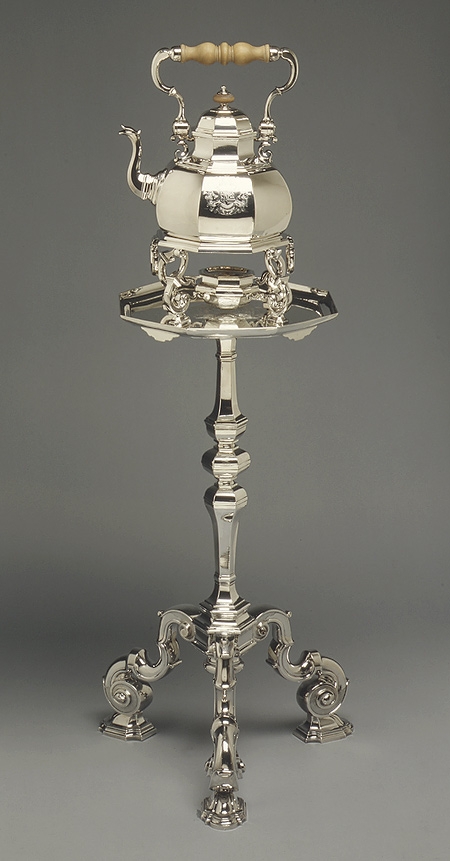
Kettle 1724-1725
The "Queen Anne" style kettle, with its stand and spirit burner and its accompanying silver table, is the most important surviving work of the celebrated Huguenot silversmith Simon Pantin, who was active in London in the first three decades of the eighteenth century.
Pantin enjoyed the patronage of influential fashionable clients, including the king. The owners of this piece of tea equipment, George Bowes and his wife Eleanor Verney, daughter and sole heir of an immensely wealthy father, lived in Yorkshire. Their combined coats of arms are engraved on the kettle, stand, and tabletop, which, somewhat unusually, can be unscrewed from the table shaft to form a salver standing on four feet. The shape of these feet, the octagonal forms of the tabletop with its upwardly curving rim, and the octagonal plan of the kettle itself derive from Chinese forms that were familiar in London at the time in imported lacquers and porcelains. The table tripod and shaft, however, were inspired by contemporary wood furniture.